![[HOME]](https://ftp.funet.fi/index/Tree_of_life/icons/home.gif)
![[INDEXES]](https://ftp.funet.fi/index/Tree_of_life/icons/warp.gif)
![[TREE]](https://ftp.funet.fi/index/Tree_of_life/icons/phylo.png) Life
Insecta
Lepidoptera
Ditrysia
Noctuoidea
Noctuidae
Xyleninae
Life
Insecta
Lepidoptera
Ditrysia
Noctuoidea
Noctuidae
Xyleninae
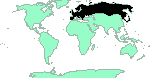 EU - Russia, Japan. See [maps]
Vielzahn-Johanniskrauteule
Purple Cloud
Hammaskuismayökkönen
EU - Russia, Japan. See [maps]
Vielzahn-Johanniskrauteule
Purple Cloud
Hammaskuismayökkönen
![[polyodon-1.jpg]](https://ftp.funet.fi/index/Tree_of_life/insecta/lepidoptera/ditrysia/noctuoidea/noctuidae/xyleninae/actinotia/_polyodon-1.jpg) 508x559 (~30Kb) Germany, Baden-Württemberg, Schönenberg, Siedlungsbereich (8°49'E, 48°57'N, 250m), 30.07.2001, Photo © Karl Hofsäß
508x559 (~30Kb) Germany, Baden-Württemberg, Schönenberg, Siedlungsbereich (8°49'E, 48°57'N, 250m), 30.07.2001, Photo © Karl Hofsäß
|
![[polyodon-2.jpg]](https://ftp.funet.fi/index/Tree_of_life/insecta/lepidoptera/ditrysia/noctuoidea/noctuidae/xyleninae/actinotia/_polyodon-2.jpg) 834x708 (~126Kb) Russia, Moscow area, 27.7.2010 (36°25'E, 56°23'N), Photo © D. Smirnov
834x708 (~126Kb) Russia, Moscow area, 27.7.2010 (36°25'E, 56°23'N), Photo © D. Smirnov
|
![[polyodon.jpg]](https://ftp.funet.fi/index/Tree_of_life/insecta/lepidoptera/ditrysia/noctuoidea/noctuidae/xyleninae/actinotia/_polyodon.jpg) 500x520 (~44Kb) FINLAND: Ka: Virolahti, 671:53, m+f 10-16.6.1995, Markku Savela leg.
500x520 (~44Kb) FINLAND: Ka: Virolahti, 671:53, m+f 10-16.6.1995, Markku Savela leg.
|
Larva on (in flowers and pods) Hypericum , H. maculatum, H. perforatum [SPRK]
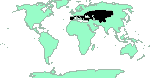 SEU, Turkey, Armenia, Turkmenistan, C.Asia. See [maps]
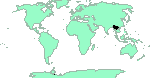 N.Vietnam. See [maps]
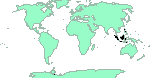 Borneo, Sulawesi. See [maps]
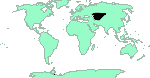 W.Turkestan. See [maps]
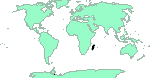 Madagascar. See [maps]
11.6.2023 (9)
Before diving into fields, the book establishes a rigorous foundation in mathematics. It covers Cartesian, cylindrical, and spherical coordinate systems, alongside essential vector calculus theorems like the Divergence Theorem and Stokes' Theorem. 2. Maxwell’s Equations
The book "Electromagnetic Waves" by R K Shevgaonkar covers the following topics:
The concept of electromagnetic waves dates back to the 19th century when James Clerk Maxwell predicted the existence of these waves based on his famous Maxwell's equations. He showed that electric and magnetic fields are interconnected and that a changing electric field produces a magnetic field, and vice versa. In 1887, Heinrich Hertz experimentally confirmed the existence of electromagnetic waves. Electromagnetic Waves R K Shevgaonkar Pdf
Biot-Savart’s Law, Ampere’s Circuital Law, and Magnetic Vector Potential are explained. The crucial concept of inductance and magnetic energy storage is derived intuitively.
The book is available for digital viewing on platforms like Scribd . Before diving into fields, the book establishes a
Prof. R.K. Shevgaonkar’s Electromagnetic Waves remains an indispensable asset for mastering electromagnetic field theory. Whether you are preparing for university exams, competitive engineering tests (like GATE), or designing high-frequency RF circuits, pairing this textbook—or its official NPTEL video counterparts—with diligent problem-solving will give you a robust, lifelong command over electromagnetics.
Professor Raghunath K. Shevgaonkar is a distinguished academician and researcher in the field of radio astronomy, fiber optics, and electromagnetics. He has served as a professor at IIT Bombay and as the Director of IIT Delhi. His extensive teaching experience spans decades, allowing him to craft a textbook that specifically addresses the conceptual hurdles students face when transitioning from basic physics to advanced electromagnetic engineering. Core Topics Covered in the Book Maxwell’s Equations The book "Electromagnetic Waves" by R
Which specific (e.g., Smith Charts, Waveguides, Maxwell's equations) are you finding most challenging?
Note: For the official and complete text, it is highly recommended to use authorized academic resources or purchase the hard copy to support the author and receive the best quality educational material.
However, it is highly recommended to look for the wealth of created by the author. Prof. Shevgaonkar’s acclaimed NPTEL (National Programme on Technology Enhanced Learning) video course, titled "Transmission Lines and EM Waves," is available for free viewing online. This video series is a perfect companion to the book, and many students recommend using both together for the best learning experience.
Wave impedance, reflection coefficients, and Standing Wave Ratio (SWR).
Before diving into fields, the book establishes a rigorous foundation in mathematics. It covers Cartesian, cylindrical, and spherical coordinate systems, alongside essential vector calculus theorems like the Divergence Theorem and Stokes' Theorem. 2. Maxwell’s Equations
The book "Electromagnetic Waves" by R K Shevgaonkar covers the following topics:
The concept of electromagnetic waves dates back to the 19th century when James Clerk Maxwell predicted the existence of these waves based on his famous Maxwell's equations. He showed that electric and magnetic fields are interconnected and that a changing electric field produces a magnetic field, and vice versa. In 1887, Heinrich Hertz experimentally confirmed the existence of electromagnetic waves.
Biot-Savart’s Law, Ampere’s Circuital Law, and Magnetic Vector Potential are explained. The crucial concept of inductance and magnetic energy storage is derived intuitively.
The book is available for digital viewing on platforms like Scribd .
Prof. R.K. Shevgaonkar’s Electromagnetic Waves remains an indispensable asset for mastering electromagnetic field theory. Whether you are preparing for university exams, competitive engineering tests (like GATE), or designing high-frequency RF circuits, pairing this textbook—or its official NPTEL video counterparts—with diligent problem-solving will give you a robust, lifelong command over electromagnetics.
Professor Raghunath K. Shevgaonkar is a distinguished academician and researcher in the field of radio astronomy, fiber optics, and electromagnetics. He has served as a professor at IIT Bombay and as the Director of IIT Delhi. His extensive teaching experience spans decades, allowing him to craft a textbook that specifically addresses the conceptual hurdles students face when transitioning from basic physics to advanced electromagnetic engineering. Core Topics Covered in the Book
Which specific (e.g., Smith Charts, Waveguides, Maxwell's equations) are you finding most challenging?
Note: For the official and complete text, it is highly recommended to use authorized academic resources or purchase the hard copy to support the author and receive the best quality educational material.
However, it is highly recommended to look for the wealth of created by the author. Prof. Shevgaonkar’s acclaimed NPTEL (National Programme on Technology Enhanced Learning) video course, titled "Transmission Lines and EM Waves," is available for free viewing online. This video series is a perfect companion to the book, and many students recommend using both together for the best learning experience.
Wave impedance, reflection coefficients, and Standing Wave Ratio (SWR).
If you have corrections, comments or
information to add into these pages, just send mail to
Markku Savela
Keep in mind that the taxonomic information is copied from various sources, and may include many inaccuracies. Expert help is welcome.