
What is Encryption?
With the increase in collaborative solutions moving to the cloud, there is an increase in cyber-attacks and data theft by accessing data through vulnerable points inside and out the network. How does encryption fit in?
With the increase in collaborative solutions moving to the cloud, there is an increase in cyber-attacks and data theft by accessing data through vulnerable points inside and out the network. How does encryption fit in?


SmartEncrypt works collaboratively with security and business continuity solutions to fill the gap and secure files containing valuable data.
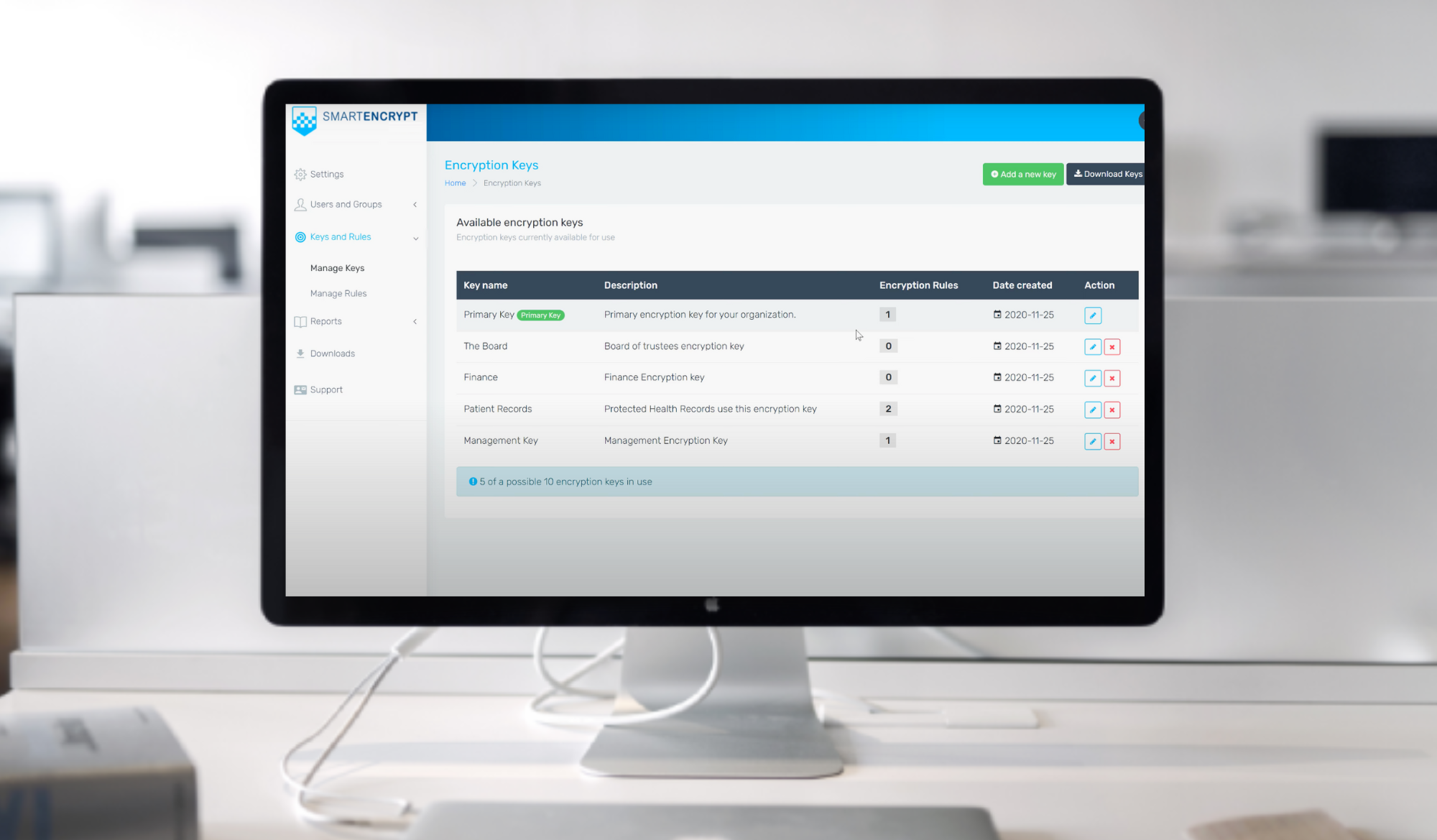
Although there are many encryption solutions currently in market, SmartEncrypt offers 5 key points of difference.
Files always remain encrypted regardless of where they travel, even after editing or moving out of an encrypted folder.
SmartEncrypt has no limitation on the size or types of files that can be encrypted. From the smallest text file to large specialist image files, all can be protected.
There are no changes to file types. Files can be opened and worked on as normal using File Explorer, or directly from within the file's associated app.
SmartEncrypt's centralised, web-based Management Console requires no hardware or software installation. And has no back-up or maintenance requirements or no ongoing associated server licensing costs.
SmartEncrypt works with files stored in both Microsoft SharePoint and OneDrive, including OneDrive’s Files On-Demand. Files remain encrypted both in and out of the cloud.
martEncrypt encodes and scrambles data so that it is unreadable and completely unusable, unless a user has the correct decryption key.
For small business with simple networks wanting control of who can access files e.g protect payroll and HR data from employees and IT
For Businesses environments requiring granular access controls e.g to restrict highly confidential files to access in the office firewall only or different teams or departments.
For large scale environments requiring granular access controls e.g to restrict highly confidential files to access in the office firewall only or different teams or departments.
This article breaks down the technical nature of the bug, the risks involved, and the steps users must take to secure their systems.
: If there are multiple users of the system, ensure they are aware of the risks and the importance of secure practices, such as not installing untrusted software.
def check_active_webcam_vuln(): """ Checks for the 'Active Webcam 11.5' unquoted service path vulnerability. Vulnerable services have a path containing spaces and are not enclosed in quotes. """ service_name = "Active WebCam" # Standard registry path for services reg_path = r"SYSTEM\CurrentControlSet\Services"
On Windows, services are executable programs that run in the background, often with high privileges. When a service is installed, its image path (the path to the executable) is stored in the Windows Registry. If this path contains spaces and is , the operating system follows a specific search order when it tries to find and launch the executable.
If a low-privileged user can write to C:\ or C:\Program Files\ (unlikely) or C:\Program Files\Active (more plausible in misconfigured systems), they can place a malicious executable named, for example, Active.exe . When the service starts (manually or at boot), Windows will run that malicious file , with SYSTEM privileges . active webcam 115 unquoted service path patched
Navigate to HKEY_LOCAL_MACHINE\SYSTEM\CurrentControlSet\Services\[ActiveWebcamServiceName] . Double-click ImagePath .
Ensure users do not have write access to the root directory ( C:\ ).
For an attacker to successfully leverage this vulnerability in Active Webcam 11.5, three conditions had to be met:
The flawed registry entries are located under: HKLM\SYSTEM\CurrentControlSet\Services\ This article breaks down the technical nature of
The patch addresses the underlying cause of the vulnerability by modifying the Windows service configuration. Specifically, the path to the Active WebCam executable is changed from an unquoted string to a fully quoted path:
To ensure your system is protected, it's crucial to apply the patch as soon as possible. Here are the steps to follow:
The final step requires triggering the service. If the low-privilege user has permission to restart the service, they can run:
When Windows starts a service, it interprets the file path sequentially if it contains spaces and lacks quotation marks. The Execution Logic Vulnerable services have a path containing spaces and
While official patches for legacy software may be limited, users can manually "patch" or remediate this vulnerability by editing the Windows Registry to secure the service path. InfoSec Governance
Although the vulnerability was publicly discussed for several years, the official patch was not issued until version 11.6. The delay highlights the importance of proactive vulnerability management: even if a vendor is slow to release a patch, system administrators should consider temporary workarounds or, in the worst case, remove the software.
The developer updated the installer logic to ensure proper string encapsulation. Modern installers use explicit quote escaping when writing to the Windows Registry.
Because the direct path segments are protected, attackers may need to look for a different attack vector. They can instead place a malicious executable in a location where they have write permissions, such as a user's temporary directory. Another more advanced tactic is to create a shortcut or symbolic link to a controlled file or to wait for a system reboot to place the malicious file if the permissions on the parent directory are weak. However, the most reliable method in many real-world scenarios involves identifying or creating a vulnerable folder in the path hierarchy that the user can write to.

“ SmartEncrypt is an amazing application that protects key data both internally at Virtual Graffiti and with our customer base. Whether the files are hosted in SharePoint, on a NAS, or locally, we know these are safe and intellectual property is protected. ”

“ SmartEncrypt makes it easy to offer my clients in the financial and professional services industry, the ability to protect their files and meet industry compliance regulations. The Protect & Share feature is ideal for sending contracts and other confidential files to their clients without risk and without their clients requiring a license to access the SmartEncrypt files. ”

“ Control access to personal and company data with trust that the keys are in my hands. SmartEncrypt solves the problem of encrypting data and keeping things simple. Gone are the days of spending hours to implement an encryption solution. SmartEncrypt is a simple turn key solution with options to secure different levels of access to files, including secure sharing of data. ”